
AERONAUTICAL OBSTACLE ASSESSMENT


ATNS - Air Traffic Navigation Services

AERONAUTICAL OBSTACLE ASSESSMENT

ATNS is responsible for conducting Annexure 14 Obstacle Assessments in line with Part 139 of the Civil Aviation Act 13, of 2009 (Civil Aviation Regulations 2011).

What is an Obstacle

The International Civil Aviation Organisation defines an Obstacle as

All fixed (whether temporary or permanent) and mobile objects, or parts thereof, that:

are located on an area intended for the surface movement of aircraft

extend above a defined surface intended to protect aircraft in flight

stand outside those defined surfaces and that have been assessed as being a hazard to air navigation.

What We Do

ATNS is responsible for conducting Annexure 14 Obstacle Assessments in line with Part 139 of the Civil Aviation Act 13, of 2009 (Civil Aviation Regulations 2011).

AIC

What is an Obstacle Assessment

Obstacle Assessment is a process where aeronautical studies are conducted to assess an impact of a proposed structure with the intent to ensuring the protection of the environment surrounding the Aerodrome from developments and activities that have the potential to impact on the aerodrome’s safe operation. Safe airport operations demand a permanent monitoring of obstacles at and around airports. It is crucial to keep them in line with the applicable obstacle limitations. The construction of new infrastructure or changes to airport operations require systematic obstacle evaluations and assessments to maintain an acceptable level of safety

What is the Purpose of Obstacle Assessment

The purpose Aeronautical Obstacle Assessment is to assess the implications of any development being proposed within the vicinity of an established aerodrome, airspace and CNS infrastructure and limit adverse impact by the proposed structure, thus ensuring the continued aviation safety.

When assessing a development for any potential impacts on aviation safety there are many factors that need to be considered


Communication, Navigation and Surveillance


Minimizing the effect of sources of non-visible radiation, or the presence of moving, or fixed objects that may interfere with, or adversely affect, the performance of aeronautical communications, navigation and surveillance systems. Proposed buildings and structures can affect equipment used by both the aerodrome and aircraft. The equipment is collectively referred to as Communication, Navigation and Surveillance (CNS) and is essentially the ground infrastructure used by both Air Traffic Control (ATC) and aircraft. Aircraft can be those approaching/departing an aerodrome as well as those further away and in the cruise. This equipment is mostly a form of radio equipment

Obstacle Limitation Surfaces (OLS)


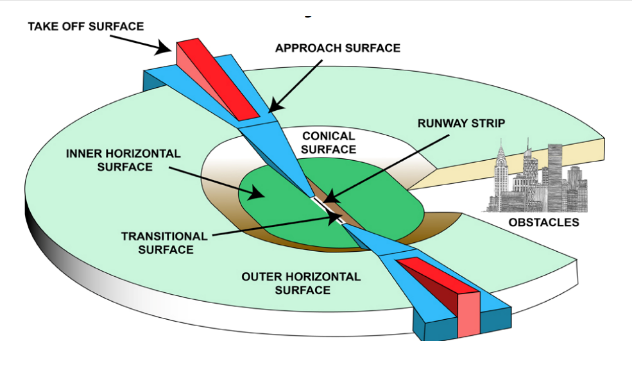
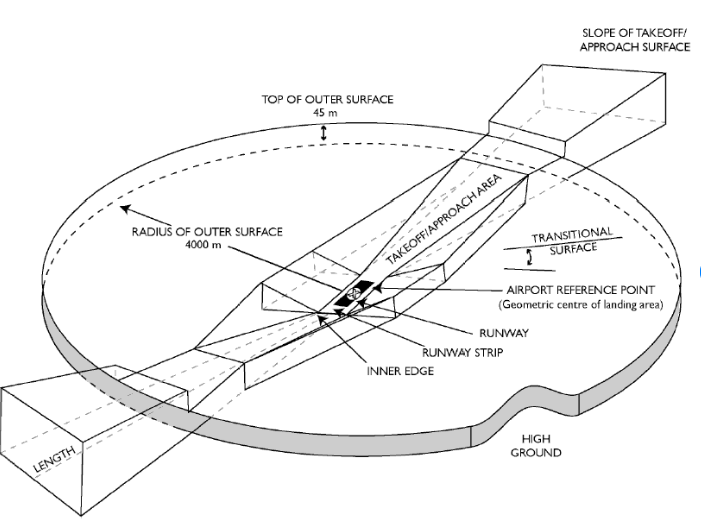
the OLS surround the airport and typically extend out to 15km from the Aerodrome Reference Point (ARP) though this can vary between aerodromes. They are designed to protect aircraft from obstacles when manoeuvring on the ground, taking off, landing or flying in the vicinity of the aerodrome. It is important that these surfaces are not infringed by new development. OLS take the form of a complex set of 3- Dimensional surfaces, which extend upwards and outwards from the runway(s).

Instrument Flight Procedure (IFP)


Instrument Flight Procedures are a series of predetermined manoeuvres, by reference to aircraft flight instruments coupled with ground based navigational aids or satellite navigation-based waypoints, with specified protection from obstacles. An IFPs primary purpose is to provide clearance from obstacles and to allow safe aircraft operations the runway to/from the airways network or the local airspace

Air Traffic Services


To ensure protection required to keep the Air Traffic Control Tower line of sight clear from any obstacles and to protect the aircraft from the risk from glint and glare, e.g. solar panels.